
One of the things I truly value about being part of The Engagement Institute’s (formerly IAP2 Australasia) Research Working Group is the opportunity to wrestle with complex questions alongside thoughtful colleagues. Recently, I had the pleasure of collaborating with Edi, Merryn, and Monique on a webinar that challenged a fundamental question in community engagement: when we talk about “social value,” what are we really measuring?
I’ve been reflecting on what we shared during that session, and I wanted to capture some of those thoughts here.
From ROI to Impact: Measuring What Matters in Engagement
A few years ago, our Working Group set out to develop an instrument to measure Return on Investment for engagement. After some really fantastic discussions, the project was put aside for several reasons. Some were simply pragmatic – as a voluntary group, we didn’t really have the time needed to truly do justice to the work. But even when we explored the possibility of getting an external organisation to work on it, writing the brief was also incredibly challenging.
The fundamental issue was this: measuring Return on Investment requires quantifying outcomes, and the conversation kept circling back to the fact that it’s really difficult – sometimes impossible – to quantify some of the most important outcomes of engagement. Some things just can’t be counted, and the framing around trying to put a monetary figure on value for the amount of budget allocated is complicated. While that’s certainly important, we all know that there is so much more that engagement achieves.
The Challenge of Counting What Counts
Relying solely on quantitative data alone also has risks. How many pop-ups? How many participants? These numbers matter, but they can lead to oversimplification or even overclaiming. A thousand people might be engaged in a process, yet it may lead to very little meaningful change – either for those participants or for the eventual policies and programs that emerge.
I also keep coming back to this point because it’s so central: different stakeholders need to understand different kinds of value. Community members experiencing transformation through participation care about very different outcomes than organisational leaders tracking community-level impact, who in turn focus on different measures than those examining broader societal impacts.
A Three-Domain Framework for Social Value
So that’s what brought us to developing a framework with three complementary domains – a way to capture the nuanced and multifaceted value that engagement creates. The framework is outlined in the table below.
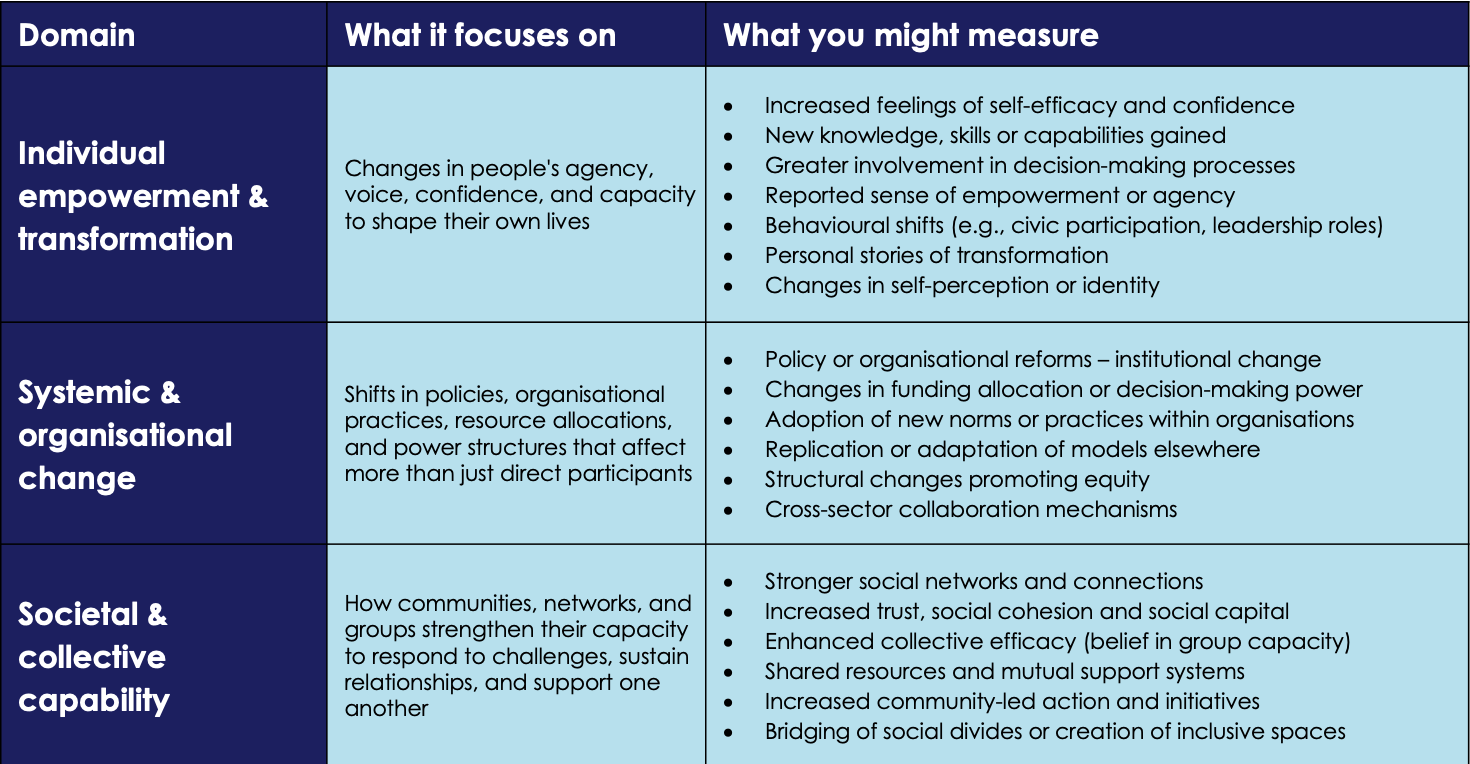
As you can see, these measures paint a much richer picture of what engagement can achieve – and we certainly haven’t captured everything! Please consider this just a first iteration and what I’m really hoping for is that it starts conversations and gets people thinking about different approaches to measurement. If you have ideas about how to strengthen or extend this framework, I’d love to hear them!
Putting It Into Practice
If you’re thinking about applying this framework to your own work, here are some principles that might help:
1. Map the ripple effects
The three domains aren’t separate silos – they’re deeply interconnected. Consider building a layered logic model that shows how change flows from individual to organisational to societal levels. For example, an engagement process might start by building an individual’s confidence, which leads to their increased civic participation, which then influences policy changes, which ultimately increases social capital. Making these connections visible demonstrates the full scope of impact in ways that participant counts alone never could.
2. Ground measures in context
This framework isn’t meant to be prescriptive. Not every measure will be relevant to your work, and there may be important indicators we haven’t captured. Work with your stakeholders to define what outcomes look like in your unique context. What does empowerment mean for the participants you’re working with? What does systems change look like in your organisation?
3. Think legacy, not just one-off projects
Social value often emerges and evolves over time rather than appearing immediately. Build in regular opportunities for reflection and learning throughout your work. This longitudinal approach helps shift engagement from a singular project framing to an ongoing practice where outcomes are incremental and generative.
4. Think in ecosystems
We can’t always draw direct causal lines for engagement outcomes. You can’t definitively say that because one person participated in a program, they ended up in a leadership position – multiple factors contribute to any individual’s journey. The same applies to organisational or societal shifts. They rarely happen because of one project alone, and that’s okay. Your engagement work still contributed – it played a part in a broader ecosystem of change. That contribution is valuable and worth acknowledging, even when you can’t claim it as solely yours.
Where to Go From Here
Here are some ways to explore these ideas further:
- Try mapping your own project across all three domains. Where does most of your current measurement sit? What might you be missing?
- Review your existing evaluation frameworks. Are you capturing cultural shifts, power dynamics, and relationship building, or just counting participants?
- Build reflection time into your projects from the start, not just at the end. Social value often becomes visible only when you create space to notice it.
- Connect with others exploring similar questions. The Research Working Group exists precisely because these challenges are shared across sectors and contexts.
- Challenge yourself to tell richer stories about your work. Numbers have their place, but they’re rarely the whole story.
- Consider creating participatory evaluation processes where community members define and assess value alongside you.
The Bigger Conversation
This framework isn’t meant to be prescriptive. It’s an invitation to think more expansively about what we’re creating through engagement work – and to resist the pressure to reduce complex human experiences to single metrics. Social value is messy, contextual, and deeply human. Our measurement approaches should reflect that reality, not obscure it.
What’s your experience been with measuring social value? Where do you see the tensions between what matters and what gets measured? We’d love to continue the conversation.
The Three Domains of Social Value Framework was developed by Emanuela Savini, Merryn Spencer, and Monique Cosgrove.
About the author

Dr Emanuela Savini
Emanuela is both a researcher and practitioner, dedicated to supporting people to participate in decisions that affect their lives and to create the change they want to see in their communities. She founded Public Value Studio as a space for expanding civic participation and now leads its work as Director.